Dwell in Me

Seeking God in the Every Day


1 Comment

Looking Anew at the Psalms

I always used to wonder about the Psalms. I mean, there are some really pretty poems in that book, right? Who doesn’t love Psalm 23, for example? And I’ve always liked the ones that clearly prophesied things about Jesus, like in Psalm 22:

“I am poured out like water, and all my bones are out of joint;
my heart is like wax; it is melted within my breast;
my strength is dried up like a potsherd, and my tongue sticks to my jaws;
you lay me in the dust of death.
For dogs encompass me;
a company of evildoers encircles me;
they have pierced my hands and my  feet–
I can count all my bones–
they stare and gloat over me;
they divide my garments among them,
and for my clothing they cast lots.” (v. 14-18)

But outside of the clear references to Jesus and the sweeter, most oft-quoted poetry, I never really cared for the Psalms.

And I sort of felt like they were poems old people liked. I mean, they don’t even rhyme in English. And I’m sure the rhthym is all off too. Not like Shakespeare. Or even Dickinson–with her half rhymes and rhythmic verses. Or e. e. cummings, whose creativity in poetry just makes you think. “anyone lived in a pretty how town/ (with up so floating many bells down).” Love that.

The rest of the Bible is a little easier for me. More concrete. You know when God is telling you to do something or live a certain way. There are stories and you can analyze them and think about their application in your own life. You can read and puzzle over Revelation and Daniel, wondering what everything really looked like to John and Daniel in these visions they’ve recorded. Trying to see what they see. But the Psalms require something different.

I’m not sure what that is. Empathy? Personal suffering? Doubts? A vision of a God who is Love? And maybe all of those things and more.

Infertility has been pain, my suffering. It has made me question God and caused me to examine him to see who he really is. It has brought me to my knees and  brought me to his throne. And it has taken me to the Psalms.

“Blessed is the man who walks not in the counsel of the wicked, nor stands in the way of sinners, nor sits in the seat of scoffers; but his delight is in the law of the Lord, and on his law he meditates day and night. He is like a tree planted by streams of water that yields its fruit in season, and its leaf does not wither. In all that he does, he prospers.” Psalm 1:1-3


“Ask of me and I will make the nations your heritage, and the ends of the earth your possession.” Psalm 2:8


“But you, O Lord, are a shield about me, my glory, and the lifter of my head. I cried aloud to the Lord, and he answered me from his holy hill.” Psalm 3:3-4


“Answer me when I call, O God of my righteousness! You have given me relief when I was in distress. Be gracious to me and hear my prayer!” Psalm 4:1


“But let all who take refuge in you rejoice; let them ever sing for joy, and spread you rprotection over them, that those who love your name may exult in you.” Psalm 5:11

And there are 150 Psalms recorded in the Bible. Praise God for this source of wisdom and empathy. For this instruction in speaking to God and relating to and understanding who he is. For this emotional connection to him and to his word that we have in the Psalms like nowhere else. Praise God for opening my eyes to the beauty in these poems, to the meat in them, to the way they can speak powerfully in my life. Praise God.

2 Comments

Who’s Serving Whom?

A few days ago I watched an episode of the remade Upstairs, Downstairs. It’s really just a poor girl’s Downton Abbey–something to fill the time while I’m working on knitted and crocheted gifts for the baby shower I’m going to next weekend. But this morning as I was laying in bed, half-waking, half-praying, I suddenly had this picture in my mind like I was the lady of the house and I was speaking to the people I’ve hired to do my beck and call–my servants.

This picture came as an overlay to my prayer. And I suddenly realized that I wasn’t praying, I was listing a litany of requests that I wanted to have filled.

The next thought  came swiftly on the first: Do I treat God as though he is my servant?

Of course, the relationship should go the other way. I should be striving in everything to serve God, my Master–which is a synonym for Lord–my leader, my guide. I am not the boss. God is the boss. I don’t even know where I’m going this afternoon; God knows every step I’ll ever take.

Yesterday afternoon, I was listening to the radio and the broadcaster was talking about sheep that live in his town. These sheep are apparenty moved from pasture to pasture around the town on a regular basis. And he said that as he was driving by the sheep he was thinking about how the Bible often compares us to sheep and Jesus or God to our shepherd. And he said, you never see one of these sheep stand up on its hind legs and tell the other sheep, “Hey, I’ve figured it all out. Follow me!” No. Instead, the sheep just sit there, mindlessly really, grazing on the good grass their shepherd took them to. They don’t even know where they are–all they know is that food has been provided for them.

If we think of ourselves as sheep under an all-loving and all-knowing shepherd, our prayer requests may come across as almost foolish. Imagine the sheep trying to tell the shepherd where it wants to go, how to get to the best pasture, the source of the water it wants to drink. The sheep doesn’t know these things. Instead, he relies fully on the shepherd to lead him and meet all his needs.

Now, this could be scary. In theory, the shepherd could be a wicked shepherd. He coud be leading the sheep to certain death just to satisfy his own evil desires. But a good shepherd would never do such a thing. Even in situations that a sheep might find confusing or frightening–like being sheared, perhaps–the shepherd knows exactly what he’s doing and why.

Praise God that he is the good shepherd. There is no wickedness or evil intent ever in the steps he lays out for us. We may stray, but he only loves us, only wants what’s truly best for us.

How much better would it be to unite myself more fully with the Father as my shepherd instead of viewing him as my equal–or worse, my servant? Why should I bother with a list of “please this” and “please that” when all I should be saying is, “thank you.” Thank you because God is the good shepherd. Thank you because even when the road seems a little rocky or the shears come close, he is leading me the right way. The good way. Thank you, because he is God, and I am not.


2 Comments

Seeking to Recognize the Supernatural

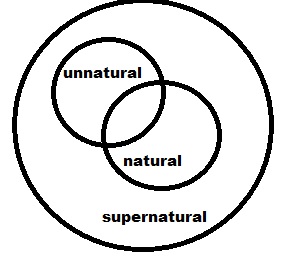
We can place all the things in the universe–tangible and intangible, actions and inactions–into three broad (overlapping) categories: natural, unnatural (or produced by man), and supernatural (driven by God).

If we had a venn diagram of these, I think it would look something like this:

venn diagram of three naturals

Inside our circle of what’s naturally occurring, we may find things like trees and native forests, wetlands, wild animals, oceans, rivers, natural resources like oil or natural gas. All of these things we consider “natural.” These things are within the supernatural circle as well because all that is natural we see as created by God.

And then, inside the circle of what is unnatural, we see man-made productions: cars, roads, houses, computers. But these still fall inside the supernatural circle, because without the brains given by God, how could these things have been created? Here I don’t intend the label “unnatural” to have any negative connotation. There is nothing inherently negative about the things man has created. Though not all unnatural things are good, neither are they all bad. The term is neutral. (In the same way, “natural” could be used to refer to things we aren’t fond of, like fire ants and poison ivy. The fact that we may perceive them as negatives does not invoke a negative or positive connotation to the term “natural” itself.)

And I believe there are natural-unnatural overlaps. For example, a grain of wheat. The wheat we have today resembles its ancient ancestors in very little respect. This isn’t due so much to a natural evolution as it is to cross pollination, genetic engineering, and other forms of modification. Domesticated animals–dogs, cats, chickens, and cows–are natural creatures that have been affected by man. Other natural-unnatural overlaps may include infertility treatments that use natural products (sperm and eggs) mixed with science to enable pregnancy. Or even natural things that are used by man to create something else, like paper (from trees) or cotton clothing.

But, because God created everything, everything is–at least in some way–within the supernatural. There is an old joke that illustrates this point:

A scientist is speaking to God. “We don’t need you anymore, God. You see, we have figured  out how to create life in a labratory. We can be self-driven and have no need for your talents.” God looks at the scientist and says, “Really? How do you do it?” And reaching down to scoop us some of the earth, the scientist says, “Well, first you take some dirt–.” But here God interrupts him. “No,” God says, “Get your own dirt.”

Some things are exclusively supernatural–that is, they wouldn’t be lumped in with any other category. As an example, the resurrection would be considered wholly supernatural. There is nothing natural about a dead man rising from the grave. And there is nothing man can do to enable a dead man to arise from the grave. This is something God has done at specific times (Lazarus, Jesus, the 500 who arose when Jesus died, etc.). He has never done it by employing man in any way to accomplish the task (Jesus did raise Lazarus from the dead–but we see this could be done only because he was fully God in addition to being fully man).  And I believe Love is supernatural. We know that God is Love (I J0hn 4:8) and we cannot love but that God allows it and pours something of himself into us. Some things–like love–are supernatural whether we choose to acknowledge their source or not.

The key to the picture remains that all things, naturally occuring and produced by man, must be linked in some way to the supernatural. The very fact of existence at all connects us to the supernatural. But at the same time, we are least likely to recognize the supernatural in our daily lives. I submit that we tend to forget who is really behind the inventions we take for granted. We tend to forget who is behind the food we eat or the scenery we witness–whether rolling virgin hills or unforgettable city skylines.

And that’s a shame.

Because if we can live our lives always looking for and finding the supernatural, we will be so much more in tune with our Creator, so much more appreciative of his love for us and his role in our lives. I think recognizing the supernatural in the everyday is a key to a more abundant and more joy-filled life.

Lord, give me eyes to see your hand in the basic, the mundane, the normal. Let me recognize your presence and inspiration in the world around me. 


6 Comments

Blessed

So Mother’s Day happened. And I survived. Actually, it was much better than last year’s. DH got me some lovely flowers and a card signed with four paw prints from our fur-babies. And we’re going to see Jesus Christ Superstar in about a month–which was, I suppose, an easing the blow/maybe soon gift to take the edge off.

I seriously love  Jesus Christ Superstar. I know it doesn’t tell the whole story, but I grew up listening to the records–yes records–every year over Easter weekend. This year, DH and I spent Easter in Colorado on a mountaintop at sunrise. And it was magnificent. But I didn’t get to listen to the music. I am so touched at the thought he put into this gift on what can be such a very difficult day.

I think things were much improved this year because we have so much hope that our time is coming soon. It’s either that, or I’ve become really detached from our infertility. Or maybe a little bit of both.

Our infertility isn’t causing the stress, the emotional duress, or the feelings of disappointment lately. Maybe I’m in the “acceptance” stage of grief. Or maybe I’m back in denial–espeically since we are actively pursuing treatments right now and any month could be the month. Either way, I’m grateful for the stability, for the peace, and for not feeling particularly distraught on Sunday. It all feels like a few enormous steps forward for me. Sigh. Happy, peaceful sigh.

And, I’ve been a negligent blogger lately. Well, I could make excuses. I seem to be neglecting the blog more and more lately, and sometimes I wonder if I’ll ever have anything worth saying again. I’m sure I will. Today’s post might not be it, but maybe the next one will. And if I keep posting I know two things to be true: 1. I’ll get back in the rhythm of the life I want to have and 2. the writing (and messages) will improve. And I so want that.

I also want to take some time this summer to make some improvements to this blog. This will involve posting more regularly, of course. And doing some research on interneting. And stay tuned for a new name and new look–hopefully soon.

I’m officially starting seminary this fall. It’s exciting and overwhelming and wonderful. I’m so looking forward to it–and I need to do a few things to get myself fit to return to school. That’s an aside. Because it’s an exciting anouncement and I make it on the heels of having done a serious amount of work to submit my application. But it feels weird to dedicate a post to it. So here. A little, tiny bit of Internet space.

I am feeling truly, completely, magnificenty blessed today. And I’m amazed to be able to feel this way in light of everything else. And so very, very grateful.

I hope this week is a joy-filled week for you. And I hope, also, that it marks my return to regular posting. Though I suppose only time will tell on that account.


3 Comments

Is Jesus Weeping with Us?

My parents’ next-door neighbor once told my mother, when she was going through a difficult time, that “God never promised you a rose garden.”

It was the first time I had heard the phrase. And it certainly wasn’t a particularly empathetic thing to say. But sometimes we can find truth even in hurtful words. While this pithy maxim was no comfort to my mother at that time, I can take some comfort in it today. It reminds me in times of doubting, when I let fear seep into my consciousness, that God is working even in the trials.

The saying isn’t in the Bible, but the Bible backs it up. Jesus told us, “In this world you will have troubles…” (John 16:33) and we see God’s servants–Abraham, Joseph, David, Jesus, Paul–suffering over and again in the scriptures. We know that “through many tribulations we must enter the kingdom of God” (Acts 14:22). And 2 Timothy 3:12 tells us, “Indeed, all who desire to live a godly life in Christ Jesus will be persecuted.”

God, his Son not sparing, has given us salvation. And he has promised us a better life to come–but that is not this life. We can take solace in Romans 8:28, though: “And we know that in all things God works for the good of those who love him, who have been called according to his purpose.” This doesn’t mean everything we experience will be good, but does assure us that every experience will be used for our good. Our hardships and trials may strengthen us or better refine us into the people God wants us to be.  “He will sit as a refiner and purifier of silver…” (Malachi 3:3).

I have confidence that God–who is all powerful–is at times restraining himself from stepping in to lift us out of our trials. I believe his love for us is more than we can even begin to imagine, and that he feels pain at our sorrows.

When Jesus went to raise Lazarus from the dead, we can be sure he knew what he was about to do. “Our friend Lazarus has fallen asleep,” he said to the disciples. “But I go to awaken him” (John 11:11). He knew before he even set out for Bethany that his friend would live again.

Yet, upon seeing the sorrow in this place, Jesus wept. He doesn’t weep here because Lazarus has died. He knows Lazarus will live again. It says, “Now when Mary came to where Jesus was and saw him, she fell at his feet, saying, ‘Lord, if you had been here my brother would not have died.’ When Jesus saw her weeping and the Jews who had come with her also weeping, he was deeply moved in his spirit and greatly troubled” (John 11:32-33).

He wept not because Lazarus had died. He wept because his friends were in pain.

What comfort there is in knowing that Jesus weeps also for us in our sufferings. That he would be moved by our pain also.

So many times I’ve thought, like Mary, “Lord, if you had been here….” Or, “Lord, if you wanted to you could take it all away. You could heal our broken bodies. You could pull us out at any moment from this trial.” And these things are true.

So why doesn’t he lift us out in immediate answer to our prayers?

If Jesus had been there, Lazarus would not have died. Mary is right to say this. But if Lazarus had not died, he could not have been raised from the dead. We see that there is more glory for God–and surely a deepening of faith for all those witnessing this resurrection–because Lazarus died. The trial–the death, the four days of mourning–was never in vain.

While I will have troubles in this world, God is using them. Not one trial will be wasted. Not one heartache will be for naught. And God must have purpose in our trials; if they were of no use to us or to him, I don’t believe he would allow them.

Maybe God will see fit at some point to step in and give us a miraculous healing. To bless us with children conceived naturally in our own home. But maybe he will give us children another way. Or maybe he is directing us to a childless life for a greater purpose and glory than we can understand.

But knowing that God has allowed trials in our lives, and that following Christ does not mean freedom from all pain or suffering or illness in this life, reminds me that in the hard times God is still with me. He is here, refining me like silver, blessing me in trials, feeling my pain and heartache, loving me and drawng me closer to himself each day.

And with that knowledge has to come grattitude. I’m thankful that he loves me enough to make me the person he knows I should be. Even when it’s painful for both of us.


4 Comments

Rejoicing with Those Who Rejoice

Joseph, favorite son of Jacob, was sold into slavery by his own brothers. The motive? That boy was daddy’s favorite, and they were jealous. Murderously jealous. In fact, if a tribe of Ishmaelites hadn’t shown up at just the right time, the original plan was to kill the boy, their brother, the favorite son of their father.

It’s really a sad story. I can’t imagine being so totally rejected by my own brothers and sister. It would be heartbreaking.

But this story has a truly remarkable ending. Joseph is raised up among the Egyptians. He becomes the number two guy in all of Egypt and prevents the people from starving during a severe, seven-year famine.

He also finds himself in a position to make an important choice.

When Joseph’s brothers who sold him into slavery appear before him wanting to purchase food for their families, he could have repaid their evil with evil. He could have sent them away empty-handed, or sold them as slaves, or even had them killed. But he doesn’t.

Joseph forgives his brothers. Yes, he makes them jump through a couple of hoops and pass a few well-designed “tests” before he reconciles with them, but we don’t see him taking vengence or holding any kind of grudge against the men who kept him from his beloved father and baby brother for over twenty years.

***

So, one of the tests Joseph gives his brothers is to see if they continue in their jealousy. He has a feast prepared for his brothers, and he feeds them all more than enough food, but he gives to Benjamin–his full  brother, the baby of the family, and his father’s new favorite–portions five times bigger than he gives all the other brothers.

And the brothers don’t complain. If they are jealous or begredging Benjamin this bonus serving, they keep it to themselves this time. The difference in treatment brings out no apparent ill-will. Instead, the Bible says, the brothers drank and were merry.

***

As we discussed this story this morning at my Bible study, someone mentioned Romans 12:15, “Rejoice with those who rejoice, weep with those who weep.” And I found it so very intereting when she said, “It seems easy to find people who weep with us when we’re weeping–but how often do we actually rejoice with others who are rejoicing?”

There’s a funny thing with infertility and the infertility community that’s been bothering meI don’t want to be insensitive, but I feel this needs to be said. As people dealing with infertility–people who want to be pregnant or have children more than most–we have a tendency to complain about other people’s pregnancies. We whine and mope about seeing pregnant bellies while we’re in the grocery store or out to dinner. We cry about pregnancy announcements and pictures of babies and bumps on facebook. We talk about how hard it is to be around people who have what we want the most.

I wish I could claim innocence here, but I know I’ve been guilty too.

And we can sugar coat it all we want. One book I read said pregnant bellies were “grief triggers.” This book–with a Christian perspective–was arguing that it is perfectly fine to foster those feelings of disappointment and sadness when we see pregnant women or new babies.

But I think we go beyond “grief trigger” and quickly end up at jealousy. And it’s not fine. We shouldn’t be okay with those emotional responses.

Maybe we can’t help it. Our emotions sneak up on us and we aren’t really ever in control, right?

But maybe we should try.

Because you know what? I’m going to be one excited lady when I’m pregnant. I’m going to be praising God and smiling and joyful–even if I’m sick and tired and feeling bloated. And I’m going to hope that people will want to rejoice with me.

And I’m not a fan of double standards.

So I’m rejoicing with you while you rejoice, dear mama-to-be.

And I’m weeping with you while you weep, dear friend still waiting.

And I’m starting now.


1 Comment

Waiting and Waiting and Why?

What’s it all about anyway?

Waiting. And waiting. And maybe some more waiting.

I don’t have an answer. But . . .

I trust the wait is not in vain.

God is using this difficulty in my life to shape me, to turn my heart to him, to transform me into the woman he wants me to be. And this shaping is an answer to prayer. Years ago, we sang the song “Holiness” in church, and I remember praying the chorus on so many occasions:

Take my heart and mold it
Take my mind; transform it
Take my will: conform it
To yours, to yours, O Lord

I believe God is doing these things through the circumstances of my life. Sometimes it’s a painful process, but I need to remember it’s an answer to prayer.

I trust that God knows what’s best (and I do not).

We’ve all heard the saying that hindsight is 20/20. I’m not convinced this is true for humans–but we can look back when we’ve seen how a situation played out and maybe see ways we could have acted or thought differently. God has the luxury of knowing what is going to happen, where we’re going,  and how we’re going to get there. God is outside of time. I think about that and try to picture what it means, and I can’t wrap my mind around it. But I find it comforting to know. I wonder if to God we are a movie he’s seen before. A good movie that he chooses to watch again. Like the celestial equivalent of Pride and Prejudice. Or Sliding Doors.

Either way, God is there, “Declaring the end from the beginning and from ancient times things not yet done, saying, ‘My counsel shall stand and I will accomplish all my purpose.'” (Isaiah 46:10)

He knows. He knows where I’m going and why I’m going this way. And he allowed this trial because he knew how he would use it for his glory and my good.

I trust that God’s timing is perfect (and mine is not).

If it were up to me, I’d have a near-two-year-old right now. But I don’t. If it were up to me, I would have gotten pregnant last month. Or the month before that. Or before that. But I didn’t.

And man, the timing just made so much sense to me last month. It meant I’d get to share with my family in person at the trip we have scheduled to visit them in mid-April. I had the anouncement all planned out. But it wasn’t God’s timing, It was my timing. And what do I know about timing?

How can I even presume to know that one month is the right month? How can I even think for one moment that I should be in a position to determine such an important thing? That I should have any say in when a precious–nay, invaluable–human life should begin?

God’s shown us through his word that his timing is indeed perfect. What might have happened to the Israelites, for example, if Joseph hadn’t been in the perfect place at the perfect time to sustain the known world–including his own family–through severe famine? I’m sure each day that went by in prison had Joseph asking, “Is today the day?” As the years went by and he kept waiting, how did he not grow weary? How did he not lose faith? But he didn’t. And God’s timing was perfect.

I trust that God is good.

We can see the end of Joseph’s story. And since we know the ending, we see that God even used Joseph’s slavery for good.

We may not all have the opportunity to see how God has used the bad things in our lives for our good. Or we may allow bitterness to creep in and hide this truth from us. We can ignore the blessings of God–especially when they come in the midst of affliction. Or we can recognize them and give him the glory as  Joseph did.

Joseph’s second son is Ephraim, “for the Lord has made me fruitful in the land of my affliction.” (Genesis 41:52b). Do we see how the Lord is making us fruitful in the land of our affliction? Are we allowing the Lord to make us fruitful in the land of our affliction?

When Joseph reveals himself to his brothers, he also reveals his faith in God’s goodness.

“As for you [my brothers], you meant evil against me, but God meant it for good, to bring it about that many people should be kept alive, as they are today.” (Genesis 50:20)

Can we look at our affliction and trust that God is good?

I trust that God is bigger. And that his ways are better.

He knows. Everything. The number of hairs on my head. The number of children I’ll have–and when I’ll have them. The location of the end of the rainbow.

And because he knows everything, I can trust that he knows the best possible outcome in any given circumstance. And even the best circumstance for any given person in any given moment. The depths of his wisdom and knowledge are infathomable.

And he is sovereign and just asking us to give our foolish attempts at control over to him, because he’s really in control anyway.

And why shouldn’t we, when we know that his ways are better?

I’m not saying it’s easy to surrender. But it is necessary. Painful, even. Yet absolutely necessary for the well-lived life.

“For my thoughts are not your thoughts, neither are your ways my ways, declares the Lord. For as the heavens are higher than the earth, so are my ways higher than your ways and my thoughts than your thoughts.” (Isaiah 55:8-9)

I trust that God loves me.

This is the key. Because if I don’t believe God loves me, then the fact that he is sovereign, all-knowing, and in control is terrifying. A capricious or unloving god would be an all-powerful super-villan. How could we trust such a god? How could we commit our lives or surrender our desires to such a god? Such a god–an unloving god–would perhaps be worth struggling against.

But praise God, he IS love. He doesn’t just love us, his being defines the term! He loves us. He weeps with us, as Jesus did at Lazarus’s tomb. He struggles with us. He hurts for us. He triumphs and rejoices with us. Our God is not a sadist–he takes no pleasure in suffering. He is a father who loves us. Truly loves us.

And this love he has for us? This love we could never even almost hope to approximate? It’s a game changer.

Oh, thank you, Father, for revealing this love to me through infertility. Because it is this love that makes me sure. This love that lets me know that you are trustworthy. And that this waiting is not in vain.


7 Comments

Falling Down, Getting Back Up

You know that feeling, when you just blink your eyes and realize a month has passed? I can’t believe my last post was February 25!

I wish I had super exciting news to report, and some good excuses for why I’ve been absent and where I’ve been. But I don’t. It’s just been a different season for me lately, and although I’ve been missing writing, I’ve also been knee-deep in those things of life that have to be dealt with. Maybe you’ve been there too? Or maybe you’re much more organized than I am and know how to line up guest posts and keep things going. Ha. Someday maybe I’ll be there.

I’ve had a tough couple of days. To be honest, I’ve been kind of frustrated about our infertility lately. I feel like it should be over already. As we keep waiting for that elusive BFP, this sense that we’re actually trying yet it still hasn’t worked has dredged up a lot of feelings I thought I’d addressed and moved through.

Apparently they were just buried.

For months now I’ve been “so well-adjusted” and happy. I’ve been self-assured and confident that I’ve learned all the lessons God could possibly be teaching me through this trial. As we’ve been studying Joseph’s story and all about suffering in I Peter for my Bible studies, I’ve read along, nodding. “Oh yes,” I’ve thought, “suffering does develop good character in us. Look what it’s done for me!”

But I’m ready to be done with infertility. I’m ready to move on. When will God agree? Can’t I graduate yet?

We went to the rodeo on Saturday. The Houston Livestock show and Rodeo is seriously amazing. And that’s coming from a yankee suburban girl. I went to the rodeo for the first time two years ago. I had no idea what to expect, and I fell in love. We missed the rodeo last year, so this was only my second trip, but it didn’t disappoint.

The Houston Rodeo has an event that, to my understanding, very few other rodeos still have. It’s called mutton busting. In this extreme sport, 5 and 6 year old boys and girls who weigh between 35 and 55 pounds are plopped onto full-grown sheep. They hold on tightly as the sheep (hopefully) runs across a pen.

Sometimes they fall off after a short distance. And other times, the adults waiting at the end struggle to get the children to release the sheep. When they fall off, they almost always bounce back up and wave to the audience.

This is the highlight of the rodeo for me. I’m a little sad I wasn’t given the opportunity to ride a sheep when I was a child, and I fully intend to sign my children up for a ride one day. They may or may not have any say in the matter…

As we sat in the outdoor tent watching the mutton busing prelims, I was feeling so emotional. I kept feeling like I was holding back tears. But there wasn’t anything to cry about.

Over the next few days, I tried to process these feelings. It came as something of a surprise to me, but I realized that I was feeling really frustrated and angry about our situation. I’ve been irritated by the injustice of infertility. Some little part of me keeps welling up and crying out, “not fair!” Like a child.

Where is this coming from? I thought I’d dealt with these feelings. I’ve been matured and made better in my trial, right? I know I’ve been blessed through infertility and yet I lost the ability, for a few days, to find joy in my trial.

I don’t have a moral to the story here. Or even a good metaphor to tie the sheep in (though I kind of wish I did). This is where I’ve been lately. Processing. Evaluating. Re-processing. Re-evaluating. And praying. And asking God to give me some clarity here, and to give me some joy.

It’s easy to blog all the good lessons I’m learning, and the amazing finds in God’s word that just make my heart leap. It’s easy, on a blog, to put on a good face and seem like everything’s fine. To play this, “look at me and how I’m blossoming” card. But I guess that’s just part of the picture.

And the other part, the part that’s easier to hide, is the “this is really hard” part. The part that whines, “are we there yet?” The part that still cries out, “It’s not fair!”

I don’t like that part. But it’s a good reminder that I still have a lot to learn. And I guess I always will.

But maybe, just maybe, I don’t have to keep learning it all through infertility? We’ll see where the next month takes us, I guess.


2 Comments

Defining ‘Good’

“Taste and see that the Lord is good.” Psalm 34:8

What is good?

I’ve been thinking about this a lot lately. How do I know if something that happens to me (or around me) is good or bad? Is it even possible to know the difference this side of heaven?

Maybe this seems a pedantic question. Or even a semantic one. But I think there may be real spiritual implications in how we define this one little word.

As with many words, we can be a little loose with our language sometimes. How often have you said something was amazing or awesome–even though you know that these words can truly, deeply, only apply to God? And what do you love? Do you love your spouse? Your shoes? That great movie? Clearly we don’t mean the same love for all things.

So, I’ll start by refining what I’m talking about when I ask this question. I’m not talking about what tastes good, what looks good, what feels good–these are clearly things open to interpretation and different for each person. I can no more determine what tastes good for you than you can for me. It is a matter of personal preference.

I’m also not talking about clear, defined standards set forth in scripture. I don’t need to debate whether God is good–in the most complete and intrinsic sense of the word. And I don’t need to debate whether no one else is good. Jesus said as much. (See Luke 18:19, “‘Why do you call me good?’ Jesus answered. ‘No one is good–except God alone.'”) Similarly, I’m not asking if creation was good or bad–as God declared all things good when he made them. That was before the fall.

I’m talking about how we evaluate the things around us. How do we view our life circumstances? Do we view them all on the basis of personal preference–if it feels good (or bad), it must be good (or bad)? Or do we view life circumstances and the trials and challenges and sufferings in light of scripture?

In Romans 8:28, we see that “in all things God works for the good of those who love him, who are called according to his purpose.”

Maybe infertility isn’t intrinsically good. But maybe it’s been good for me.

Count it all joy, my brothers, when you meet trials of various kinds, for you know that the testing of your faith produces steadfastness. And let steadfastness have its full effect, that you may be perfect and complete, lacking in nothing. (James 1:2-4)

If I am living in light of eternity, and living as a sojourner and alien in this world, then what is good and what is bad is going to take on a new meaning. What causes pain or suffering or temporary discontent in this life may be bringing me closer to God. What I see as “bad” and what causes suffering may be integral to developing my relationship with God. And does that not make such events–or at least the repercussions of such events–good?

The world is full of evil, don’t misunderstand me. And the devil will play his games and work his tricks to try to pull us down. But I would submit that if we are living life in view of eternity, we won’t be fooled by the devil’s schemes. We can’t be brought down into the pit of despair when we know that God is truly for us (Romans 8:31).

Bad things happen. I’m not saying that bad things are good. But if we believe, if we trust God in everything, if we do not fear the world because we aren’t of this world–even the worst things can be used for good in our lives.

And so I ask again–can we define what is good? Because I don’t think I can trust my instincts. I think knowing what is good for us and what is bad for us is impossible this side of heaven.

And what are the spiritual implications of not being confident in our definitions here?

There is one who knows. One who knows that the difficult childhood you went through directly relates to your acceptance of the Son. One who knows that the wealth and prosperity you received in this earth did nothing but distance you from himself. One who knows how to bless us–even when that blessing includes a baptism by fire and trial and pain–so that we will truly know him. And since he knows and I don’t, I must choose to trust him and trust his direction for my life–even when it goes against my hopes or plans or sense of what is good.

All the “good” things this world can offer us are really bad if they pull us away from God. All the “bad” things in the world that push us on our knees and draw us to God and Christ are a gift to us. When I’m with God, if I have any care whatsoever about this life I’m living now, I’ll not be surprised to hear him say, “That trial of infertility? I allowed that in your life. I did it because I love you, and because I knew it would draw your heart closer to mine.” And what response can there be to that but a heartfelt thank you?

So I give up on trying to value my circumstances. And I say, why not thank him now?

But whatever gain I had, I counted as loss for the sake of Christ. Indeed, I count everything as loss because of the surpassing worth of knowing Christ Jesus my Lord. For his sake I have suffered the loss of all things and count them as rubbish, in order that I may gain Christ and be found in him, not having a righteousness of my own that comes from the law, but that which comes through faith in Christ, the righteousness from God that depends on faith–that I may know him and the power of his resurrection, and may share his sufferings, becoming like him in his death, that by any means possible I may attain the resurrection from the dead. (Philippians 3:7-11)


4 Comments

Even One Thing

This year, DH and I made a goal together to memorize one Bible verse together each week. We’ve started with 24 verses from the book of John (as provided by Ann Voskamp on her blog A Holy Experience). 

We’ve memorized John 1:1,

In the beginning was the Word and the Word was with God and the Word was God.

And John 1:5,

The light shines in the darkness and the darkness has not overcome it.

John 1:14,

And the Word became flesh and dwelt among us. And we have seen His glory, glory as of the only Son from the Father full of grace and truth.

John 1:16,

Because he was full of grace and truth, from Him we all received one gift after another.

John 2:5,

Do whatever He tells you.

John 3:16,

For God so loved the world that he gave his only begotten Son, that whosoever believeth in Him shall not perish but have everlasting life.

And this week, John 3:27,

A person cannot receive even one thing unless it is given him from heaven.

It’s been fun memorizing scripture together. We’ve been quizzing each other, which makes it easier to keep the verses memorized. And I know if we weren’t doing it together I would have given up, probably right around John 1:16 (that one was so tricky for some reason).

But this week’s verse has really opened my eyes to something that maybe should be obvious but which I had been missing.

A person CANNOT receive EVEN ONE THING unless it is given him from heaven.

This means the baby I’m hoping for will be from heaven–from God–whether it’s conceived miraculously without any help, or with the most help possible. If God wants to give us a baby, he will do it when he will and in whatever way he desires. And if, for some reason, this is not his will (or not his timing), he will prevent it.

I don’t have to worry if going forward with infertility treatments is God’s will or not. God has not given me any reason to question going forward with treatments, but if he desires our infertility to continue or to be resolved in a different way, he will make that happen, because we cannot receive a baby through ART (or any other means) unless it is given from heaven.

I find peace in this. It came at a time when I was really questioning: What is God calling me to do today? What is his will or desire for me right now? What’s plans can I make for tomorrow?

And the beautiful answer? I don’t need to know.

I choose to love God, to put him first, and trust that he will take care of the rest. He is for me–he has shown me this time and time and time again.

And besides, a person cannot receive even one thing unless it is given him from heaven.